A Story of Kinglets on a Mountain Top
At just over 6,600 feet of elevation, Mount Mitchell is the highest point east of the Mississippi. Nested in the Black Mountains of North Carolina, the peak acts as a sort of magic mirror to a subalpine ecosystem, giving us in the Southeast the opportunity to see plants and animals otherwise out of our reach. Because of this, it’s one of the few southern breeding grounds for the Golden-crowned kinglet.
Kinglets are as close to fairies as we have in this world. They materialize from the trees, wing beats like a whisper to perch on the outer extremes of a limb in a feat that seems to defy even the small traces of gravity that’s left for birds. Then, before the world truly recognizes them, they return to whatever realm they call home.
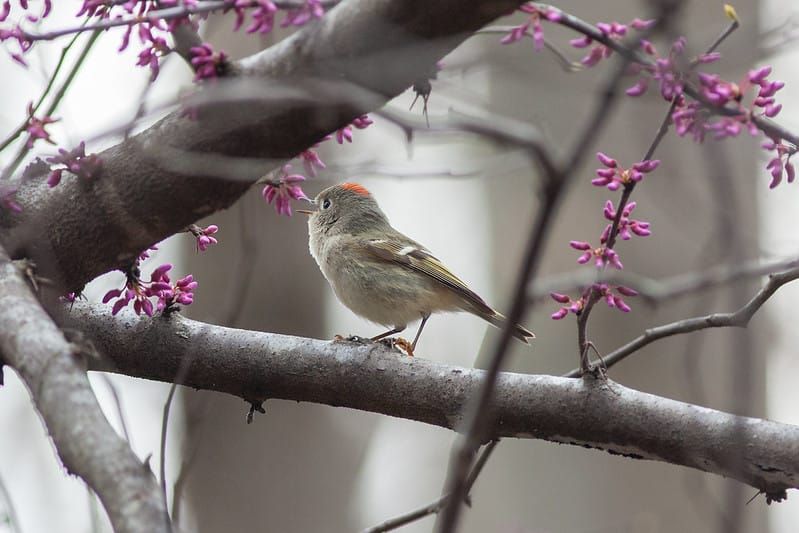
There are two types of kinglets in the United States—the Golden-crowned and Ruby-crowned kinglets. Similar in size and behavior, what really differentiates them (the males, at least) is the color of the firey crown atop their heads.

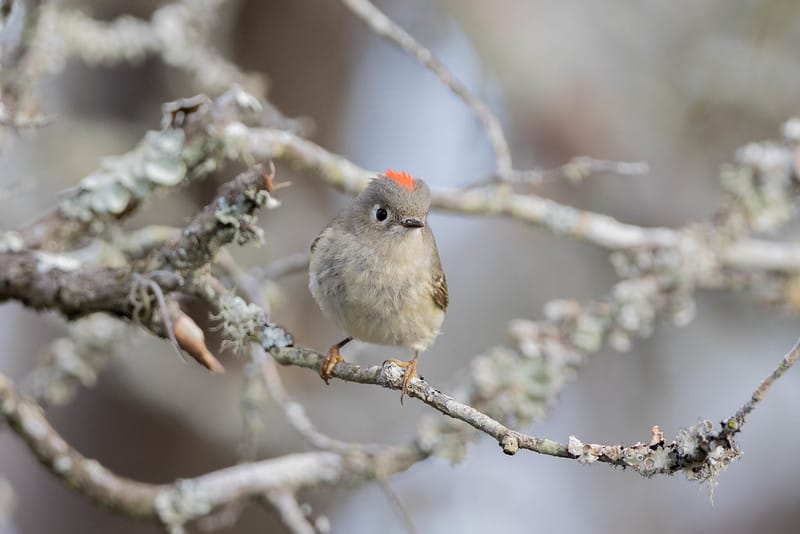
Often heard before they are seen, kinglets have a call so faint you’d think it would break the moment it touches your ear. And maybe it does, sending a million pieces of song swirling through the forest down to the leaf-littered floor to be lost forever.
They are wispy and fragile and ethereal. They are some of my absolute favorite birds.
At the summit of Mount Mitchell, there is a trail that’s roofed by spruce and fir trees. The path is well-worn by countless footfalls, and the moist earth is covered in a mix of decomposing leaves and needle boughs. A fog lingers, though a hint of sun urges it on. The world is muffled, breathless, blanketed, and so quiet. I, too, make little noise as I walk on the padded path.
There is an absence of wind. So much so that it almost seems as if my breath is every so slightly pulled from my body.
I walk on in near-complete silence. It’s then the faint chirp. However, chirp is almost too harsh a word for the kinglet’s call. It’s a blink of a noise, a faint squee that seems to somehow manifest and vanish simultaneously.
I stop and wait—head tilted back towards the best estimate of where the bird is amongst the thick spruce and fir limbs.
Bird watching is often hardly more than seeing some movement in your peripheral only to find a wind-touched branch, falling leaf, or squirrel. The utter stillness atop the mountain is ideal for catching sight of birds. There is very little movement that’s not done with purpose and intent.
And then, there it is. The kinglet forms itself into existence mid-way along an uppermost branch. It bounds from between the needles before taking to the air, zipping over the path to alight in another tree.
As if some silent understanding is reaching, the trees are full of kinglets. There must be half a dozen, sometimes ten, bounding and zipping from branch to branch and tree to tree. I stand still, afraid that any movement will disrupt the tenuous pact we’ve unknowingly reached. Soon enough, the only noises of any substance are the soft chips and the subtle staccato wingbeats as they pass overhead.
This flurry of actively lasts for maybe five minutes before I’m again left in silence. The kinglets have dematerialized and moved deeper into the forest, well beyond the trail. Well beyond where humans belong.