Chasing a Sparrow
Bachman’s Sparrows are elusive little things. They are a shy bird (as opposed to a Cardinal or Mockingbird) and live only in certain and diminishing habitats. Plus, they are sparrows, a group of birds I’ve struggled to differentiate since I started birding*.
Fortunately for me, Piedmont National Wildlife Refuge (which I’ve mentioned before) is covered in long-leaf and old-growth pine forest—the preferred habitat for the Bachman’s. I’d been several times before with no luck.
I’d seen on eBird that a Bachman’s had been spotted. The comments said something like “seen in the typical location.” I emailed the spotter and got the “typical location.” My time was now.
*Little Brown Job, or LBJ, is a tongue-in-cheek birding term that perfectly describes the experience of trying to identify a sparrow. When something small and darkish streaks past, the only answer to “what was that?” is LBJ.
It was cool day. I drove across the dyke alongside Pond 2A and parked at a metal gate. Other than a truck with an empty boat trailer, I was alone. Before getting out of my car I listened to Bachman’s song several times. It starts with a bit of a skree before trilling into song. It was distinct enough that I felt I could pick it out.
Beyond the gate, the gravel road continues between the forest. Old-growth forests, especially those at Piedmont NWR, are a different experience than most forests across the southeast. They are far more open than you might imagine. Controlled burning keeps the undergrowth minimal, though at the moment, the grass is about waist high. The trees themselves are spread out, giving a feeling of expansiveness that other forests lack
I walk up a slight rise. It’s a birdful day. The melodic Yellow-throated Warbler, the laser-shot Cardinal, and the urgent rattle of the Downy surround me as I walk along.
At the top of the ris, a portion of the forest has been felled, tree trunks mix with the muddy tracks of heavy machinery. I hear a sharp skree followed by a trilling song. The Bachman’s is nearby.
I’ve been working on birding by ear for some time now. It’s tricky for a lot of reasons. Beyond being able to identify the type of bird by call, it’s sometimes challenging even to figure out where a bird is by sound alone. So many factors can influence sound.
The volume of a particular bird, its location (on a high limb vs. in a scrub bush), and objects between the bird and me all impact the perceived direction of the sound.
A Carolina Wren has an outsized voice, so if I hear a faint wren’s song, I know that it’s probably further away or buried down in scrub. A kinglet, on the other hand, can be right above me and still be almost whisper quiet.
All this to say that I’ve stood in front of a tree listening to an obvious song for minutes on end and not seen a damn thing until the bird moves.
The Bachman’s song is clear and distinct, so I figured it was out in the open rather than buried in brush. I slowly start across the mangled earth, stopping at each song and reorienting my direction accordingly.
I’m about halfway across the field, some 40 or 50 yards to the next stand of trees, when I stop. I’ve figured the sound is coming from somewhere in the mid to upper limps of one of the pines, which is good news. Birds in the lower scrub are much more challenging to see. I scan the trees with my binoculars, though I expect not to find anything.
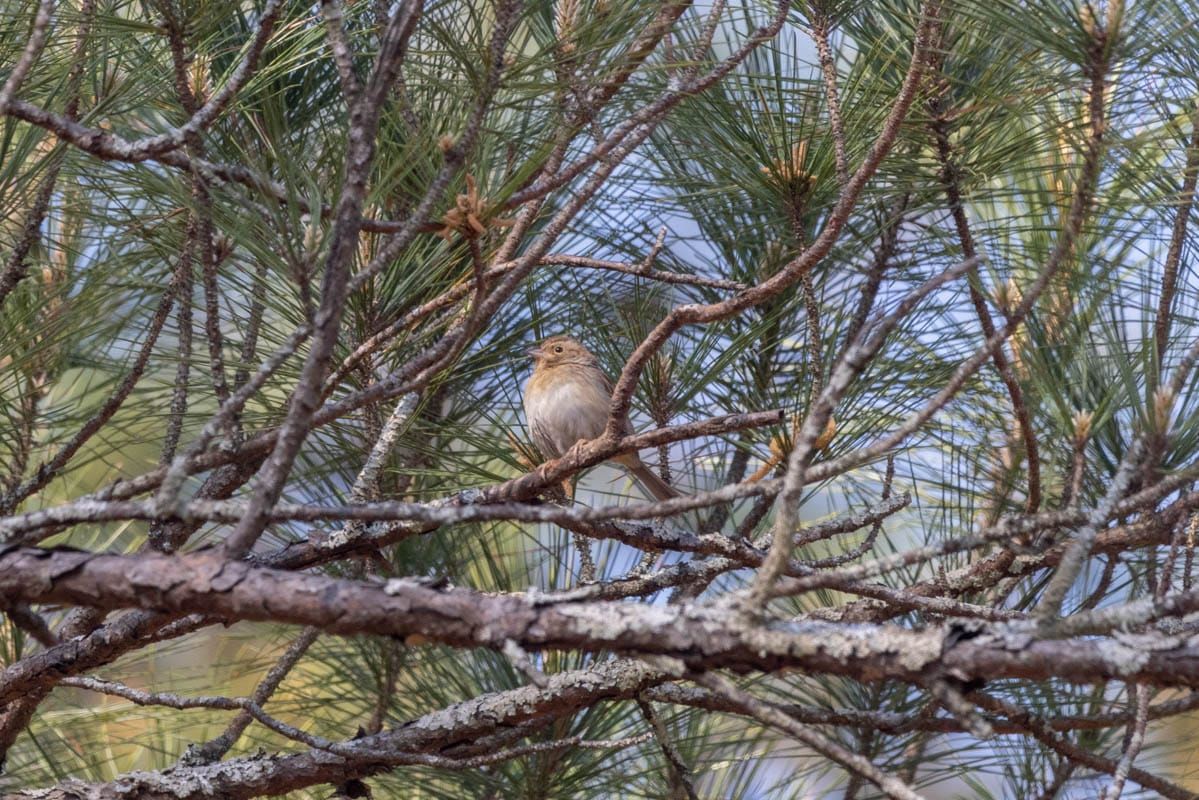
And there it is, midway out on a pine limb, tucked just behind a bough of needles, singing its heart out. I make note of a particular feature of the limb so I can keep track of it and begin slowly moving closer. I take a couple of photos and then listen and watch.
There is a certain satisfaction in tracking a bird. Perhaps it taps into some primal feeling. Maybe it’s attuning your senses to a specific purpose, listening to slight changes in pitch and volume, in feeling the ground underfoot as you gaze upwards. In peeking behind the curtain as you uncover an animal’s natural camouflage.
The sparrow sings for five or so minutes more. Tiring of its perch, it dives from the branch and drops frighteningly quickly. Then, mere feet from the ground, it spreads its wings and darts into the undergrowth and out of sight.