Do Birds Watch Us Back?
I took an Eastern Religions class my freshman year of college. The professor, a wonderfully woodsy adjunct, talked about his experience of nature experiencing him.
That was needlessly complicated. Let’s try again.
My wonderfully woodsy adjunct spoke of hiking and how, if you’re paying attention, you can sense the animals around you reacting to your presence. The birds call a bit differently, the squirrels chatter more, and there is more rustling in the underbrush. In reflection, I think he was referring to being aware of our impact on the world and how we should remember that we are visitors to the woods. That we are interrupting countless lives with our presence and to act accordingly.
There are times in stillness when a bird perches on a branch very near me.
It was a hot morning. The mist had long burnt off, and I sensed that the birds were slowing their activity down. I stopped under a tree that, in early July, still offered a semblance of cool. I stood and waited with no real intent. Then, the soft flurry of wingbeats. I could tell there was a small presence above me.
In my early days of bird watching I learned some valuable lessons about controlling movements. Once, early on I thought I’d seen a kingfisher in a tree. That’s a fuckin kingfisher I exclaimed loudly. The bird flew off before I could identify it. Lesson learned.
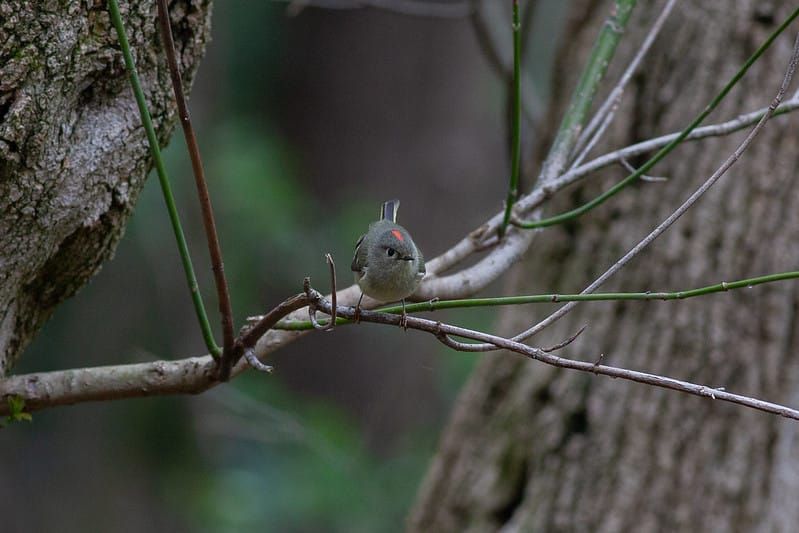
So, I stood stock still. Then, very. slowly. turned on my heel until I was facing the tree. And there it was, not more than six or seven feet from me, a Ruby-crowned Kinglet.
One tidbit that I learned early on from a good friend and fellow birder is just how hard it is to determine the size of birds, especially when they are on their own. The combination of movement, distance, and no reference point makes it very difficult to gauge how big or small a bird is.
Let me tell you, Ruby-crowned Kinglets are tiny. Like, super small. Like, 4-inches-long and weighing-as-much-as-a-US-nickel small.
It’s always an odd experience for me to be so close to something so fragile yet so full of life. I think there is the pure physicality of the situation that stands out. The dissonance of me, a full-grown human being so close to a bird that could easily fit in the palm of my hand with room to spare.
It’s also rare, for me at least, to be that close to a wild animal. I know I’m a visitor in its home. To be graciously received by proximity is something unique. If our wonderfully woodsy adjunct is correct, nature responds to our presence. Then surely nature returning to its normal activity is a sign of welcome, right?
I know this is a lot of projection on my part. But I also wonder at just how big of a world these tiny creatures inhabit. We tend to think of wild animals as acting purely on instinct, or, as one textbook famously put it, “the so-called ‘four Fs’: fighting, fleeing, feeding, and mating.”
But I believe there is more—that a bird’s experience of the world is much broader than we can imagine. We know corvids play; we know that Phoebes return to the same nest with the same mate year after year. Just think how much we don’t know of the richness and fullness of their lives.
I stood there for maybe five or six minutes, just watching the tiny little bird hop from branch to branch. It seem unconcerned I was so close and just went about it’s day. After five or six minutes, it was clearly time to be somewhere else. The little bird took flight and disappeared in the branches of a tree across a field.
I watched the tangle of swaying green leaves even though the bird was well out of sight. I silently thanked the bird for its time, for being so close, and continued on my way to disappear into my own tangle of swaying green leaves.