Origins of An Obsession: Part 1
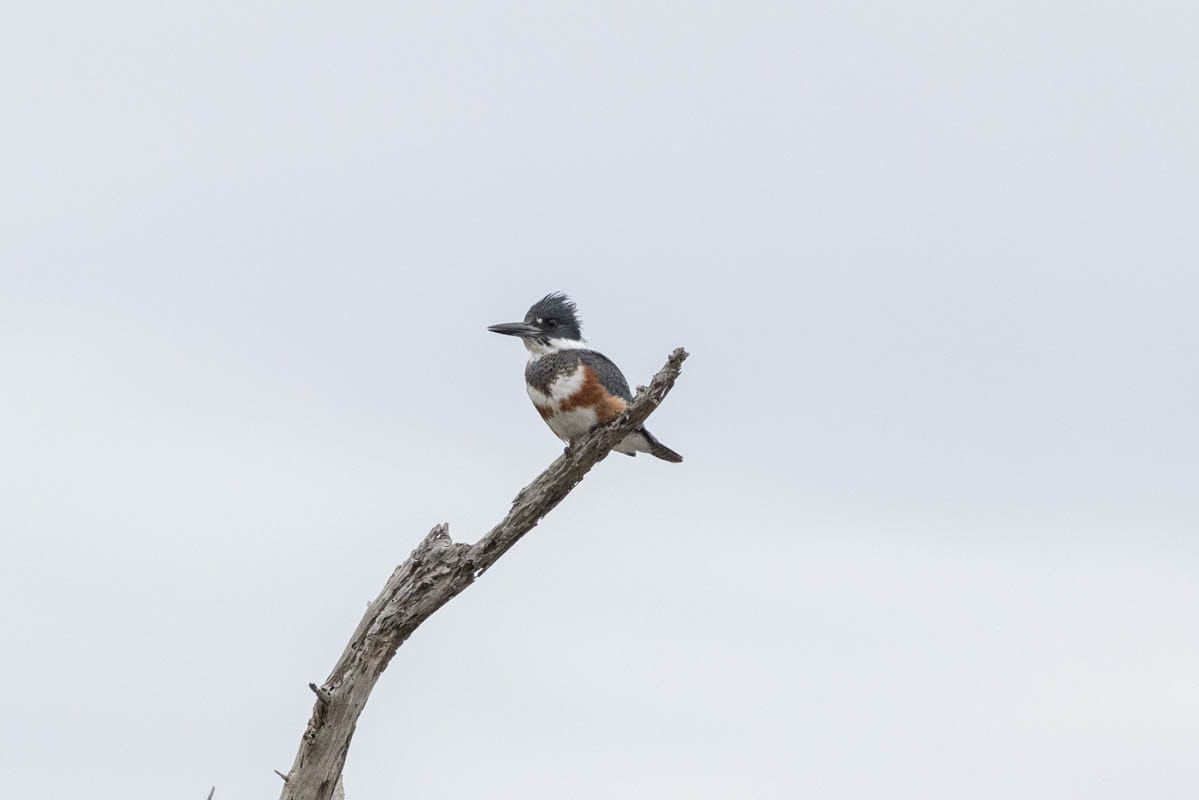
The Belted Kingfisher is one of my all-time favorite birds. The Belted Kingfisher is a goofy-ass-looking bird. Body too small, hair too crested, beak too big. But it holds a special place in my heart.
I grew up in a small town in South Georiga—name a Nashville (in the local parlance). I wasn’t a bird watcher then, but my dad was. He’s the one who first pointed out the Kingfisher that frequented a pond back behind our house.
I don’t remember much of it. What I do is strikingly distinct, however.
It’s always a summer evening in my memories. The woods that sit back a ways from the pond are far darker than the field the pond sits in. It’s not a large body of water by any means, but enough to double the gold and red-streaked sky in the mirrored stillness of the water.
It’s hot. However, that’s not unique to this reflection—the overall theme of any memory of South Georgia is the heat. But the evenings bring a settled-in hot. You move a bit freer, knowing the worst is past for the day.
My dad would fish, and I would ramble. He never caught a lot, but I’m learning that perhaps that wasn’t the point. We didn’t talk a lot so, really the only noise was the quiet click, wisp, and swirl of his fishing line.
Then, breaking through that muted and rhythmic sound, the quick clattering of the Kingfisher. It’s a call that, under most other circumstances, I’d think was coming from a woodpecker. But it’s somehow more insistent, more urgent.
Then there is the bird itself. A blue streak, higher over the water than you’d think for a bird that hunts fish. It darts across the water from perch to perch, that rattling call accompanying each journey over the water. When it spots something like its prey, it will hover over the water. Again, at some 15 to 20 feet in the air, it seems far too high to be efficient, especially considering its methods.
And then there is the method. Once it has a fish spotted, it's a sharp diving blur, then splash. And, just as quickly as it entered the water, it’s back to the surface, back to its perch to enjoy its meal.
The Kingfisher, like a lot of birds of prey, has the ability to keep its head completely still while hovering. Think of it like a gyroscope or steadicam. This allows the bird to better focus on its prey.
It's got fantastic vision. It can compensate for the reflection of the water, allowing it to judge better where to strike. It can eat fish that seem waaaay too big for it. That’s not a main reason why I like them, but it doesn’t hurt.
They also live in burrows along the banks of rivers and lakes. They are extremely territorial. Just big-ass beaked jerks of the freshwater ways, the Kingfisher.
I haven’t lived in South Georiga in many years, and I’ve intentionally put both time and distance between myself and there.
There is something, though, of those summer evenings. The comfortably oppressive heat. The aimless rambling. The quiet in between the cast and reel that was only punctuated by the rattling call passing overhead, tree to tree, perch to perch. Nothing more than a flash, a splash, and then the unraveling of fishing line.