Origins of an Obsession: Part 2
Outside of calls and songs, there are certain traits that birds have that can help you quickly identify them. With some, it’s their coloration, like the bright white throat and yellow eyebrows of the White-throated Sparrow. Others, like the Eastern Towhee, scrump along the ground*, kicking up leaves.
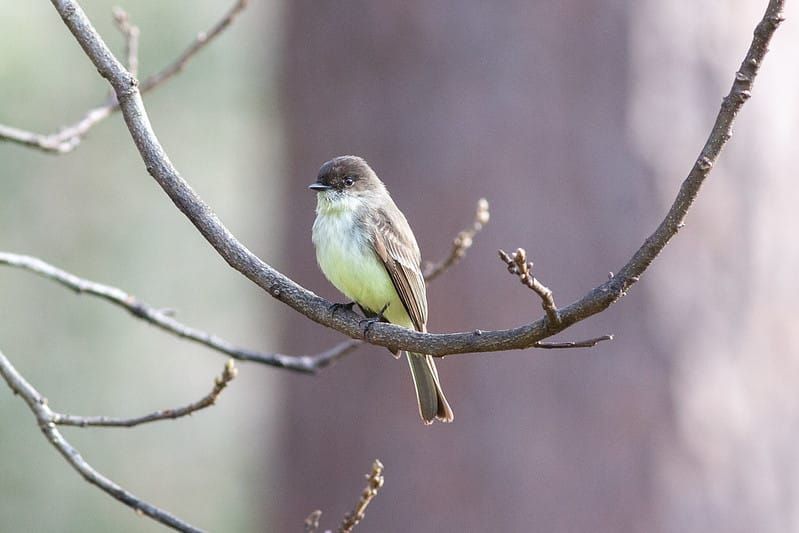
And some, like the Eastern Phoebe, do an amazingly cute tail flip. It’s so distinct that it even helps them stand out from birds that look strikingly similar.
*As far as I know there isn’t a single ornithologist that uses the terms “eyebrows” and “scrump along the ground,” but I don’t live by their rules.
The house of this story was one of those that had a front door we barely used. The door was up one step and recessed slightly. That’s important.
The house had a smallish front yard but a yard that still had plenty of trees—a row of three dogwoods, a tall pine, and what I think was a sweet gum tree. There was a wire, cable or other sort, that ran from the house to a telephone pole by the street.
I first noticed the Phoebes perched on that wire. There were two of them, and they would take turns swooping over the yard before returning to their perch. Phoebes are flycatchers, meaning they tend to catch insects on the wing rather than pulling their meals from the ground like Robins or pouncing on their food like Bluebirds.
I had only just started to regain an interest in birds, so they were a mystery to me to begin with. This was before I’d overrun my bookcases with bird guides, and Merlin hadn’t done picture IDs yet, so I did the only thing I could think of—I sent a terrible phone picture to a birder friend. (side note: one part of taking up bird watching that I didn’t anticipate was getting all sorts of random texts with pictures of birds. I love every single one of them.)
It was a random spring day in 2017—we’ll say April since April is the springiest of all months. I opened the rarely used front door, and something shot out into the yard. It was small and fast and scared the bejeebus out of me. I looked up, and there, balanced on the side of the light fixture, was a bird’s nest.
Small twigs, moss, and random bits were woven into a small bowl. It was seemingly plastered together with mud, and bits of dried dirt speckled the area around the nest. It was adorable.
In time, I noticed the Phoebes coming and going from the porch. It was amazing to see the dart towards the front door and jet upward at the last moment. Pretty soon, we began to hear the chirps of tiny birds and, eventually, a couple of straggly juveniles hopping around the bushes of the front yard. We had a bird family. And, honestly, I thought that’s the last we’d see of them. But, to my surprise and delight, they returned the next spring.
By mid to late summer, most birds will stop returning to their nests. The chicks have fledged, and the urge to reproduce has waned along with any desire to be tied to a particular spot. It was at some point between the summer 2018 and early 2019 that the Phoebe nest was destroyed. This time, I was sure that they wouldn’t return.