Origins of an Obsession: Part 3
At some point in February of 2019, I noticed the Phobes were back at it. I checked the front porch, and sure enough, there were the startings of a nest. I sprung into action.
Before the birds got down to the serious work of nest building, I set up a watch stationusing an unused Google Nest camera.
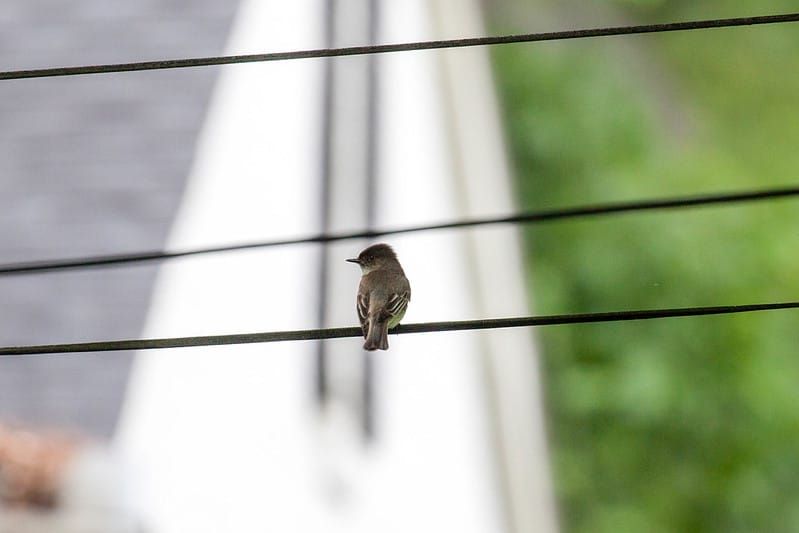
Eastern Phoebes are pretty distinct in the realm of backyard birds. Their grey/brown coloration and huge looking head help them stand out from the Blue Jays, Blue Birds, Robins, and Cardinals that are most common. They also have a very unique call, pheee be! pheee be!
They tend to stay with their partner for years and, as I learned later, will often return to the same nest year after year. Both male and female Phoebes are involved in nest building and in feeding the babies. And, like a lot of birds, they can be territorial and will get feisty when other birds or people get close to their nest.
They are also the first “uncommon” bird I could recognize by sight and sound. It’s a small thing, but it made me feel like I was actually a bird watcher instead of just someone who sort of liked birds. It’s like the first time you understand something in a foreign language. To this day, I still LOVE the call of an Eastern Phoebe.
The Phoebes became a part of my daily routine. In between work meetings or other tasks, I’d check on their progress. I was there when the two of them were together, both bringing materials for their new home. I witnessed a minor scuffle between the Phoebes and a pair of House Finches with designs on a free house. And eventually, I saw the completion of the nest.
They became a part of our lives, two little additional feathered family members.
While all this was happening on our front porch, there was another form of nesting inside the house. My wife and I were expecting our first child that May and, in our own way, were preparing as vigorously and nervously as the birds. So, while our Phoebe friends were busy crafting a home for their babies out of grass and mud, I was putting together a crib. As they were fighting off Finches, I was fighting with the instructions for a bassinet. Same same.
And, before we knew it, there were eggs and, shortly after that, four tiny squeaking baby birds.
Some things I learned after watching our Phoebes.
- The female sits on the eggs until they hatch. After that, both the male and female* bring food to the babies.
- The babies are loud! Whenever even a hint of a parent came around, they started shrieking for food.
- From what I could tell, the parents were pretty good about making sure all the babies got roughly the same amount of food. So, if one worm fed two, then the next worm would go to the ones that hadn’t gotten a piece of the first.
- They are very clean. I learned this by noticing that the parents would do this…uh…trick with the baby's poop. Basically, the baby turned around, and the parent scooped the poop out of the nest. Here’s a video if you’re curious.
- Watching fledging birds leave the nest is terrifying. They don’t seem like they should be able to fly, and yet they are just throwing themselves out. It’s wild.
*There’s not really a great way to tell male and female Phoebes apart. I just picked up on the fact that there were times when both birds were at the nest with food at the same time.
Mentally I was freaking out about becoming a father. I was also identifying with a family of birds—worried about their safety, wishing the best for the babies as they grew. Looking back, it was an odd time.
Something that stood out to me is the absolute certainty that wild animals have in life. Maybe it’s innate, a natural byproduct of the overriding survival instinct so many animals have. But at no point did the baby birds seem anything but utterly confident in their life’s journey.
As they got bigger and bigger, it was clear that their time in the nest was coming to an end. There simply wasn’t room, and I imagine the parents were probably tired of the increasing food budget. The babies tested the air with some short leaps from and back to the nest, their little fuzz-covered wings working overtime at the effort. Then, one by one, they lept out, never to return.
In the days after, I’d catch a glimpse of a goofy-looking juvenile Phoebe sneaking around the bushes, waiting for mom or dad to bring them another snack. And, then, they moved on from that as well.
I’d see the parents flying around the year, perching on this branch or that wire, but birds really only use nests for eggs and babies, not as permanent homes. So, the nest was empty for the rest of the year.
In May, our son was born, and shortly after, we moved to a new house. I like to think that the Phoebes have returned year after year. I like to think of their little quirks. I like to think of their natural confidence in the face of a jump that is sure to take them into a world much bigger than they could ever imagine.