Who Cooks For You?
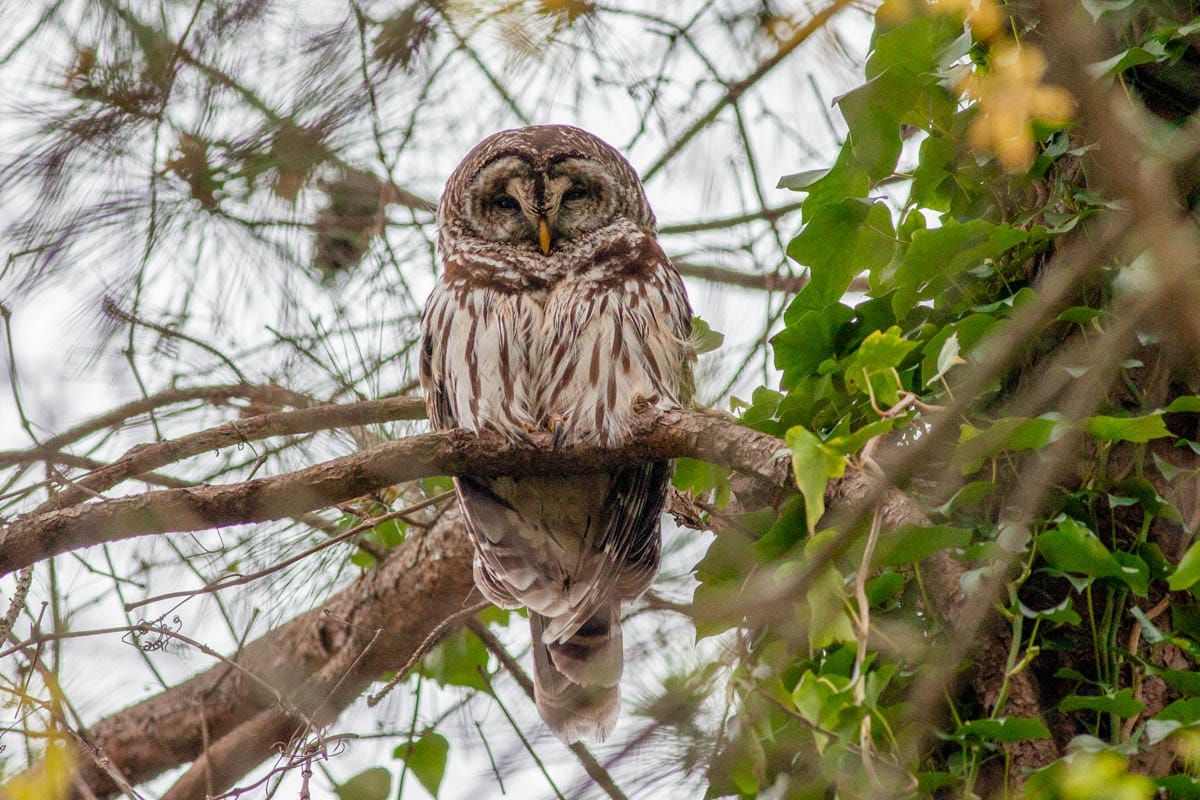
The Barred owl is a chunky piece of bird, which always surprises me for some reason. Though I rarely see them, they are consistently larger than I expect when I do catch a glimpse of them.
Those lucky enough to see one during the day are treated to more brown and grays than imaginable. The impressive thing is the depth and beauty that comes through despite the relatively simple color palette. Layers and layers of brown and gray feathers weave together, somehow both delicate and foundational.
Their silence and stillness are intimidating. Most birds, when perched, will restlessly preen, their heads snapping this way and that, constantly on guard. Barred owls, however, are languid, bored—secure in the knowledge that very little in the world sees them as prey (this is common in many birds of prey—it pays to be at the top of a food chain). They are some of the very few birds that seemingly have the luxury of being still.
I’ve only rarely seen a Barred owl in flight. Through a combination of biology and strategic gliding, they are nearly noiseless flyers. Their wings are abnormally large for their bodies, enabling them to fly slowly and reserve their wingbeats. Often, the only times I’ve seen a Barred owl in motion is when they alight on a branch that just happens to be in my field of vision. It’s almost as if they materialize in a location rather than fly to it.
More often than not, I hear their call (whoo cooks for you), often several hours after the sun has set and the darkness has settled in or in the earliest hours of the morning just before the sun rises. It’s especially pleasant to catch a pair calling back and forth, forever ignoring the other culinary-related questions.
There are a couple of birds that I feel lucky to see in the wild. Hummingbirds are up there, but they are typically active during the day, so it’s not as surprising to see one zipping around.
Owls don’t belong to the day. Everything about the way they are built is designed for silence and darkness. To see one, then, feels like watching nature slip up. As if, just for a moment, the natural order fractures every so slightly, and we get a chance to witness something not meant for us.